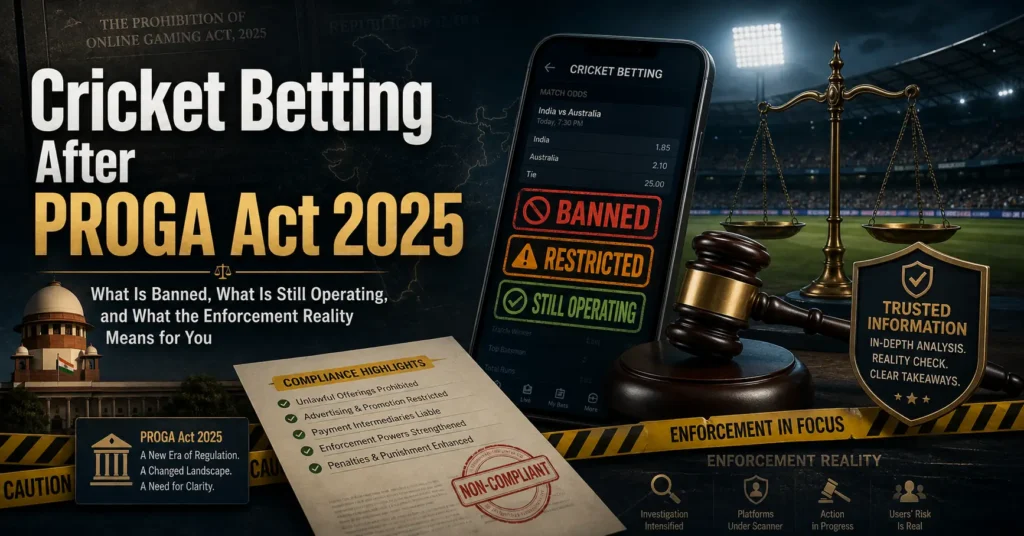
The PROGA Act came into force in August 2025 and raised the question cricket betting after PROGA act ! changed the cricket betting landscape in India more significantly than any law in the previous fifty years. But “changed” does not mean “ended.” Nine months after the ban, millions of Indian users are still betting on cricket — through offshore platforms, alternative payment routes, and a rapidly evolving grey-zone ecosystem that the legislation has not been able to shut down.
This page covers what that reality actually looks like in 2026. Not what the law says on paper — that is covered in full on Is Online Cricket Betting Legal in India 2026? — but what has materially changed for an Indian bettor since August 2025, what continues to work, what no longer works, where the genuine risks now sit, and how the enforcement picture has developed on the ground.
If you were betting before August 2025 and want to know what is different now — this is the page for you.
Disclaimer: This page is for educational and informational purposes only. It does not constitute legal advice. Online cricket betting is prohibited in India under the PROGA Act 2025. Use of offshore platforms is your personal legal responsibility.
What the PROGA Act Actually Changed — And What It Did Not
The most important distinction to understand about the post-August 2025 cricket betting environment is this: the legislation changed the infrastructure of betting in India far more than it changed the volume of betting.
What Genuinely Changed After August 2025
Fantasy cricket platforms went offline for real-money play.
Dream11, MPL, My11Circle, and every other major domestic fantasy sports platform suspended real-money cash contests within weeks of the Act coming into force. These were the only regulated, domestically-hosted real-money gaming products Indian users could access legally before the ban. They are gone — at least in real-money form — pending the outcome of the Supreme Court challenge and the SRO certification framework.
UPI deposits to cricket betting after PROGA act platforms became unreliable.
The Act’s payment intermediary provisions required banks and UPI operators to block transactions to prohibited platforms. Banks began implementing transaction blocks against known cricket betting merchant accounts in late 2025. By early 2026, UPI deposits to several offshore cricket betting platforms were failing at a significantly higher rate than before the ban — not universally, but consistently enough to create real friction.
New fraudulent cricket betting platforms increased sharply.
The post-ban environment removed most of the informal community quality-control mechanisms that helped users identify reputable platforms. With less open discussion possible and users moving to less familiar operators, fraudulent cricket ID providers multiplied. The March 2026 Nagpur Police operation — 42 accounts frozen — was one visible indicator of this acceleration.
Advertising of cricket betting disappeared from mainstream Indian media.
Prior to August 2025, offshore cricket betting platforms ran advertising on Indian websites, social media, and occasionally television using surrogate marketing. Post-ban enforcement of the advertising prohibition has been more consistent — mainstream advertising has largely stopped, though Telegram and WhatsApp promotion continues.
What Did Not Change After August 2025
Offshore platforms continued to operate.
Laser247, TigerExch, LemonBook, and similar operators hosted outside Indian jurisdiction were already functioning beyond the reach of Indian law before August 2025. The Act did not — and practically could not — shut them down. These platforms continued to accept Indian users, maintain WhatsApp support channels, and process deposits and withdrawals throughout the post-ban period.
The volume of cricket betting among Indian users did not fall.
Offshore platform usage rose from 68% to 82% of all Indian online betting activity in the months following the ban. Total betting volume did not decrease — it redistributed. Users who had been on domestic fantasy platforms moved to offshore cricket betting operators.
Individual bettors were not prosecuted.
No documented case exists of an individual Indian user being prosecuted solely for placing a bet on an offshore cricket platform since August 2025. All enforcement actions have targeted operators, agents, and payment intermediaries.
Offshore cricket betting after PROGA act — The 2026 Reality
Why Offshore Platforms Are Beyond Direct Enforcement
The fundamental challenge for Indian authorities enforcing the cricket betting ban is jurisdictional. A cricket betting platform hosted in Curaçao, Malta, Gibraltar, or the Isle of Man is not an Indian legal entity. It does not hold an Indian licence. Its servers are not on Indian soil. Indian law cannot compel a foreign-registered company to cease operating any more than it can compel a foreign government to change its policies.
What the legislation can do — and is doing — is target the connective tissue between Indian users and offshore platforms: the payment routes, the advertising channels, and the domestic agents facilitating access.
How Offshore Platforms Adapted
The offshore cricket betting platforms serving Indian users adapted to the post-ban environment in several ways:
Payment method diversification. Platforms that previously relied entirely on UPI began actively promoting crypto payment options — USDT (Tether), Bitcoin, and other stablecoins — as primary deposit routes. Some platforms introduced e-wallet intermediary layers to create distance between the user’s UPI transaction and the final recipient.
WhatsApp network deepening. Post-ban, the WhatsApp agent network — where local agents facilitate deposits and withdrawals on behalf of users — became more central to how offshore platforms operate in India. This created new fraud risks, as distinguishing genuine agents from scam operators became harder without public forum discussion.
Domain diversification. Platforms began operating multiple domain variants simultaneously — so that if one domain was blocked by Indian ISPs, users could access the platform through an alternative URL. This also significantly increased the risk of clone website fraud (see Cricket Betting ID Scam India 2026).
Which Platforms Continued Operating
The offshore cricket betting platforms with the most documented continued operation post-ban include established operators with multi-year histories — platforms that had verifiable user bases and domain histories before August 2025. New platforms launched after the ban should be treated with significantly higher scrutiny — the post-ban period has seen a sharp rise in platforms that operate for one IPL season and then disappear.
UPI and Banking After the cricket betting after PROGA act — What Changed
UPI Transaction Blocking
The most tangible day-to-day change for Indian cricket bettors since August 2025 has been payment friction. The Act requires banks and payment intermediaries to block transactions to prohibited platforms — and implementation has been gradual but real.
What this looks like in practice:
- A UPI transfer to a cricket betting platform account that processed smoothly in July 2025 may now fail with an error code — “transaction declined,” “beneficiary account restricted,” or “payment blocked by bank”
- The same platform’s account may work via one UPI app (Google Pay) but fail via another (PhonePe) on the same day — because different banks implement the blocks at different speeds
- Platforms rotate their UPI collection accounts in response — which increases the fraud risk, because users can no longer verify accounts against any stable reference point
Crypto as the Alternative
The most significant payment shift post-ban has been towards cryptocurrency — primarily USDT (Tether on the TRC-20 network) — for offshore cricket betting deposits and withdrawals. Platforms including Laser247 and LemonBook had already offered crypto payment options pre-ban. Post-August 2025, crypto became the primary promoted payment method on several platforms.
The trade-offs of crypto for cricket betting payments:
- Transactions are not reversible — if you send crypto to a scam platform, there is no UPI dispute mechanism and no chargeback
- Crypto transactions are not linked to your bank account in the same way — reducing UPI blocking risk
- The 90-day UPI dispute window that provides some financial recourse for scam victims does not apply to crypto transactions
- Crypto-to-INR conversion involves exchange rates and fees that reduce effective returns
Your Bank’s Legal Position
Post-August 2025, your bank is legally required to block transactions to prohibited platforms. If your bank processes a UPI transfer to a cricket betting account, the bank itself is technically in violation of the Act’s intermediary provisions. Banks are therefore implementing blocks with increasing consistency as compliance pressure increases.
This has a secondary effect: some users have reported that repeated cricket betting transactions — even pre-ban ones — have triggered account-level flags at some banks, resulting in requests for explanation or temporary restrictions on UPI outward transfers.
How Enforcement Has Actually Worked Since August 2025
What Enforcement Has Targeted
Since the Act came into force, documented enforcement actions have focused on three categories:
- Platform operators and WhatsApp agents
Police operations across multiple states — most prominently in Maharashtra, Telangana, and UP — have targeted individuals running cricket betting agent networks, managing WhatsApp groups for offshore platforms, and operating as domestic intermediaries for offshore operators. These individuals are the visible, prosecutable face of offshore cricket betting within Indian jurisdiction. - Payment mules and collection accounts
The financial network behind offshore cricket betting relies on Indian bank accounts to collect UPI deposits before converting and moving funds. Targeting these accounts — freezing them, identifying account holders — has been the most effective domestic enforcement tool. The Nagpur March 2026 operation that froze 42 accounts is one example of this approach. - Advertising and promotion
The advertising prohibition has been enforced against Indian-registered websites, social media accounts, and YouTube channels promoting offshore cricket betting platforms. Several Indian affiliate websites promoting cricket betting were deindexed or received removal notices in early 2026.
What Has Not Been Enforced
Individual end users — people placing cricket bets for personal use on offshore platforms — have not been the target of any documented prosecution since August 2025. This is consistent with how gambling prohibition has worked historically in India: enforcement targets the supply chain, not retail consumers.
This enforcement reality does not eliminate legal risk for users. The statute creates the prohibition. Enforcement policy and statutory provision are different things — and policy can change, particularly if the Supreme Court challenge is resolved in the government’s favour and political pressure to demonstrate enforcement increases.
The Supreme Court Factor
The ongoing Supreme Court challenge to the Act creates genuine legal uncertainty that affects everything downstream. If the Court issues a stay of certain provisions — or strikes down the Act in whole or in part — the entire enforcement and compliance picture changes. If the Court upholds the Act fully, enforcement pressure may intensify.
As of May 2026, no stay has been issued. The law is in full force. But its long-term status remains genuinely uncertain.
Responsible Cricket betting after PROGA act— What the Ban Changed
One of the underreported consequences of the cricket betting ban is its effect on responsible gambling infrastructure.
Before August 2025, India had limited but developing responsible gambling resources — the major domestic fantasy platforms had some self-exclusion and deposit-limit features, and public awareness of problem gambling helplines was growing alongside the industry.
Post-ban, users have moved to offshore platforms that have no obligation to provide responsible gambling tools under Indian consumer law, no requirement to signpost helplines, and no regulatory accountability for problem gambling outcomes. The ban removed the limited domestic player-protection infrastructure while doing nothing to reduce the volume of real-money cricket betting.
If you are concerned about your own cricket betting behaviour — or someone else’s — please use India’s free, confidential helplines. These services exist regardless of the legal status of the activity.
Free Helplines — India:
- iCall India: 9152987821 (Monday to Saturday, 8 AM to 10 PM — free)
- Vandrevala Foundation: 1860-2662-345 (24 hours, 7 days a week — completely free)
- NIMHANS Bangalore: 080-46110007
- Sumaitri Delhi: 011-23389090
Frequently Asked Questions — Cricket Betting After PROGA Act 2025
Q: Can I still bet on cricket in India after PROGA?
A: Legally, no — cricket betting is prohibited under the Act. Practically, millions of Indian users continue to access offshore cricket betting platforms that operate beyond Indian enforcement jurisdiction. Individual bettors have not been prosecuted. But the statutory prohibition exists and carries legal risk.
Q: Which cricket betting platforms are still working in India after the ban?
A: Offshore platforms — those hosted outside India — have continued to operate. Platforms with multi-year verified histories and established user bases before August 2025 are the most reliable indicators of continued genuine operation. New platforms launched after the ban carry significantly higher fraud risk. Do not deposit with any platform you cannot independently verify through pre-ban user reviews.
Q: Why is my UPI payment to a cricket betting site being blocked?
A: The Act requires Indian banks and UPI operators to block transactions to prohibited platforms. Banks are progressively implementing these blocks. You may find the same platform’s UPI account works with one payment app but not another, or stops working suddenly — because platforms rotate collection accounts as blocks are applied.
Q: Did Dream11 shut down after PROGA?
A: Dream11 suspended real-money cash contests following the Act’s enactment. Free-to-play fantasy formats remain available. Dream11 is part of the Supreme Court challenge arguing that skill-based fantasy cricket should be exempt from the prohibition. Real-money Dream11 contests are not currently available in the form they existed before August 2025.
Q: Is it safe to use crypto for cricket betting in India after the ban?
A: Crypto payments bypass UPI blocking but carry their own risks. Crypto transactions are irreversible — there is no dispute mechanism or chargeback if you are defrauded. The 90-day UPI dispute window does not apply. Crypto also involves conversion costs and exchange rates that reduce effective returns.
Q: What is the Supreme Court doing about the PROGA Act?
A: A constitutional challenge has been admitted by the Supreme Court, filed by gaming companies arguing the Act overreaches its authority and violates the established skill-chance legal distinction. Proceedings are ongoing as of May 2026 — no stay has been issued, no ruling date confirmed. The Act is fully in force until further notice.
Q: Has anyone been arrested for cricket betting in India since the ban?
A: Arrests since August 2025 have targeted platform operators, WhatsApp cricket betting agents, and payment mule account holders — not individual end users placing personal bets. No documented prosecution of an individual bettor solely for using an offshore platform has occurred as of May 2026.
Q: What is the biggest risk for individual cricket bettors in 2026?
A: Fraud is the most immediate risk — the post-ban environment has significantly increased fraudulent cricket betting platform activity. Legal risk exists but enforcement against individual users has not occurred. Payment risk is real — UPI blocking and the loss of consumer protection mechanisms for offshore transactions.
Related reading — recent guides on this site
- Cricket ID Types Explained — The account landscape as the regulatory picture shifts.
- Cricket ID Family Sharing Risks — Why account structure matters more under stricter rules.
- Cricket ID vs Fantasy Cricket App — The two products under different regulatory treatment.