Staying safe on a colour-prediction app is less about picking the right colour and more about protecting your phone, your passwords and your bank account from the people who circle around these platforms. This guide walks through the clone sites, fake APKs, OTP tricks and Telegram “VIP” schemes that tend to follow them, and what to do if money goes missing. It is an informational explainer, not an invitation to play, and everything here assumes you are 18 or over.
Why Account Safety Matters First
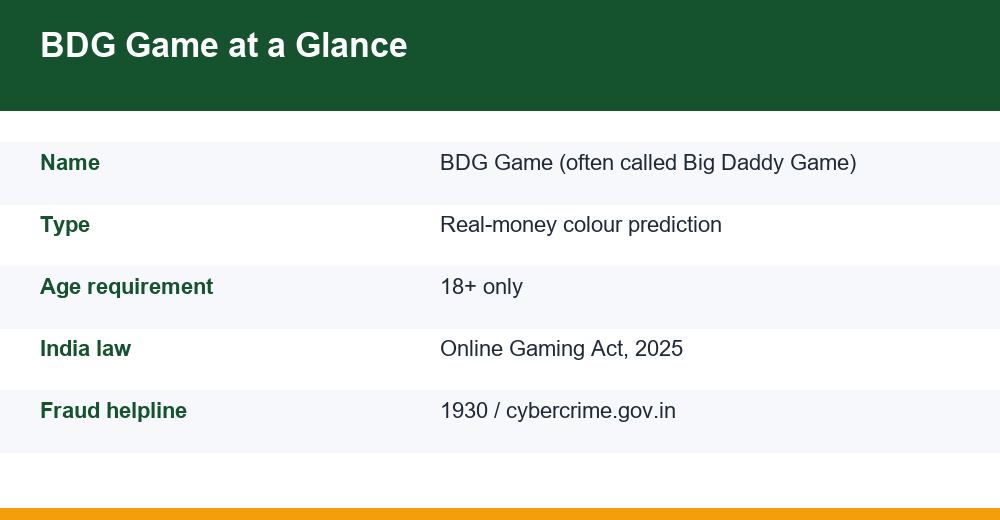
The app this guide focuses on, often described online as Big Daddy Game, is a real-money colour-prediction and multi-game platform aimed at players in India. Rounds run on short timers, and players stake money on a colour, number or size outcome. That speed matters, because rushed decisions are exactly what scammers exploit.
Before any security tips, three plain facts. Real money is at risk every time you stake. Results are chance-based and the platform builds in a house edge, which means the expected value for players is negative over time. And these apps are strictly 18+ only. No security setting changes those facts; it only stops you losing money to third parties as well.
If you have ever looked at bonus offers on such apps, our explainer on how casino bonus wagering maths really works shows why “free” credit usually locks up your own deposit rather than adding value. The same scepticism is a good habit for everything that follows.
The Legal Position in India in 2026
India’s Promotion and Regulation of Online Gaming Act, 2025 received Presidential assent in August 2025. It prohibits offering online money games, which it defines broadly as games played with a deposit or stake in the expectation of winning money or other rewards. It also bans advertising and promotion of such games and bars banks and payment providers from facilitating transactions for them.
The Ministry of Electronics and Information Technology notified the accompanying Rules in April 2026, and the Act and Rules came into force on 1 May 2026. Penalties are aimed at operators, advertisers and those facilitating payments rather than individual players, whom the government has described as victims rather than offenders.
This is a brief summary, not legal advice. Check the official text of the Act and Rules, or consult a qualified lawyer, if you need a definitive answer for your situation.
Ten Habits That Keep Your Account Safe
These steps apply whether you already have an account or are simply researching the app. They are the same habits that protect any UPI-linked account, so they are worth learning even if you never stake a rupee.
- Use only the address you have verified yourself. Type it manually or use a saved bookmark; never follow links from chats, ads or SMS.
- Never install APKs sent by strangers. A file shared on Telegram or WhatsApp can contain malware that reads your SMS and OTPs.
- Use a unique, long password. Do not reuse your email, UPI or banking password anywhere else.
- Never share passwords or OTPs. No genuine support team needs your OTP, UPI PIN or login password.
- Keep your UPI PIN private. You enter your PIN only to send money, never to receive it.
- Lock down your phone. Use a screen lock, keep the operating system updated and remove apps you do not recognise.
- Turn off unknown-source installs after any check. Leaving this setting on invites silent installs later.
- Ignore ‘agents’, ‘mentors’ and ‘VIP predictors’. Paid signals cannot beat a random outcome with a house edge.
- Set firm money and time limits. Decide in advance, and stop when you reach either limit.
- Report fraud immediately. Call 1930 or file at cybercrime.gov.in as soon as you notice an unauthorised debit.
Spotting Clone Sites and Fake APKs
Popular apps attract copycats. A clone site copies the logo, colours and layout of a known platform, then collects logins or deposits that never reach a real account. The domain often differs by a single letter, an extra hyphen or a different ending.
One site that publishes background information about the app is bdggameloging.com. Even so, treat any page that asks for money or passwords with care, compare addresses character by character, and be wary of lookalike domains that appear in search ads or social posts.
Warning signs of a fake APK
- It asks for permission to read SMS, access contacts or act as an accessibility service.
- It was shared as a file in a group chat rather than downloaded from a page you checked.
- Your phone warns that the file is harmful or from an unknown developer.
- After installing, you see new apps, pop-ups or battery drain you cannot explain.
SMS and accessibility permissions are the dangerous combination. Together they can let malware read your OTPs and tap buttons on your behalf. If an app demands these, uninstall it and run your phone’s built-in security scan. And any “mod” or “hack” version that claims to predict results should be treated as malicious by default, because no tool can foresee a random result generated on a server.
A quick check before you log in
- Read the full address in the browser bar, not just the logo on the page.
- Look for the padlock, but remember it only means the connection is encrypted, not that the site is honest.
- Compare the domain with the one in your own bookmark, letter by letter.
- If a page opens straight onto a deposit screen with a countdown timer, close it.
- When in doubt, do not log in at all; nothing on these apps is genuinely urgent.
Agent and VIP Prediction Frauds
A large share of the risk around colour-prediction apps sits outside the app itself, in Telegram channels and WhatsApp groups. These channels sell “VIP prediction” signals, recruit “agents” or offer to “recover” lost money. They are dangerous precisely because they feel social and friendly.
The maths behind paid signals is simple. If an outcome is random, past results do not predict the next one, and no paid signal changes the house edge. A channel showing a winning streak is simply showing you the winners it chose to post.
The ‘agent’ and recovery angles
“Agents” may offer to top up your wallet at a discount or handle withdrawals for a fee. You send money to a personal UPI ID and rely entirely on a stranger’s honesty. “Recovery experts” target people who have already lost money, asking for an upfront fee to get it back. Both should be refused outright. Since promoting online money games is itself prohibited under the 2025 Act, a channel aggressively pushing deposits is a warning sign on legal as well as safety grounds.
OTP and UPI Scams Explained
Most account takeovers do not involve clever hacking. They rely on persuading you to hand over a code or approve a payment, so recognising the common scripts is most of the battle.
- Fake customer care: “Your withdrawal is stuck; share the OTP to release it.”
- Collect request trap: a UPI request disguised as a refund or prize, which actually debits you when you enter your PIN.
- Screen-share request: being asked to install a remote-access app “to fix your account”.
- KYC panic: “Your account will be blocked today unless you verify now via this link.”
- Withdrawal fee: “Pay a tax or unlock fee first, then your winnings will be released.”
The golden rule: you never need to enter a UPI PIN to receive money. Any message telling you otherwise is a scam, whoever claims to send it. Likewise, OTPs are meant for you alone, and sharing one is the same as handing over your account.
If a caller creates urgency, hang up and contact the service yourself using details you already trust. Real organisations will not threaten you with a five-minute deadline. And read every UPI screen before approving it: a collect request from an unknown name, or an amount you did not agree to, should be declined.
An illustrative example of a typical script
Consider a made-up but realistic scenario. A player sees a withdrawal marked as pending for a few hours and complains about it in a group chat. Within minutes, a stranger sends a private message claiming to be from the support desk, along with a convincing screenshot of an “internal dashboard”. The stranger says the withdrawal can be released once the player approves a small one-rupee “verification” request. The request that arrives is actually a collect request for a much larger amount, and the player only notices after entering the PIN. Every part of this script is a warning sign: the unsolicited contact, the move to a private chat, the time pressure and the request to enter a PIN in order to receive money. The safe response is to ignore the message, block the sender and check the withdrawal status only inside the app or through contact details you found yourself.
What to Do If You Lose Money
If you notice an unauthorised debit or realise you have been tricked, act straight away. Reported transactions can sometimes be flagged and held before funds move further, which is why officials urge victims to report as early as possible, ideally within the first hour.
- Call the national cybercrime helpline 1930 and describe the transaction.
- File a complaint on the National Cybercrime Reporting Portal at cybercrime.gov.in, keeping the acknowledgement number.
- Contact your bank or UPI app to block your card, UPI ID or account if needed.
- Change passwords and your UPI PIN from a clean device.
- Save evidence: transaction IDs, screenshots of chats, phone numbers and website addresses.
- Do not pay any “recovery agent” who contacts you afterwards.
Being honest about losses matters too. If chasing losses, borrowing to play or hiding spending from family sounds familiar, it is worth talking to someone. Tele-MANAS, the government’s free mental-health helpline, is available around the clock on 14416 or 1-800-891-4416 in many Indian languages.
Finally, remember the simplest protection of all. Every round carries a built-in house edge, and no channel, agent or app can turn that into reliable profit. Choosing not to deposit is always a legitimate, and often the safest, decision.
Frequently Asked Questions
Is it legal to play in India?
The Promotion and Regulation of Online Gaming Act, 2025, which came into force with its Rules on 1 May 2026, prohibits offering and promoting online money games in India. Penalties target operators, advertisers and payment facilitators rather than players. This is a general summary, not legal advice.
Can VIP prediction groups on Telegram really predict results?
No. If outcomes are random and carry a house edge, past results cannot reliably predict the next round. Paid signal groups typically show selected wins, collect fees and then disappear. Treat any ‘guaranteed’ prediction offer with deep suspicion.
Should I ever share my OTP with app support?
Never. No genuine support team needs your OTP, UPI PIN or password. Anyone asking for them, whether by call, chat or email, is likely trying to take over your account or move your money, so end the conversation immediately.
What should I do first if money disappears from my account?
Call the cybercrime helpline 1930 straight away, then file a complaint at cybercrime.gov.in and keep the acknowledgement number. Inform your bank or UPI app, change your passwords and PIN, and save all transaction IDs and chat screenshots as evidence.