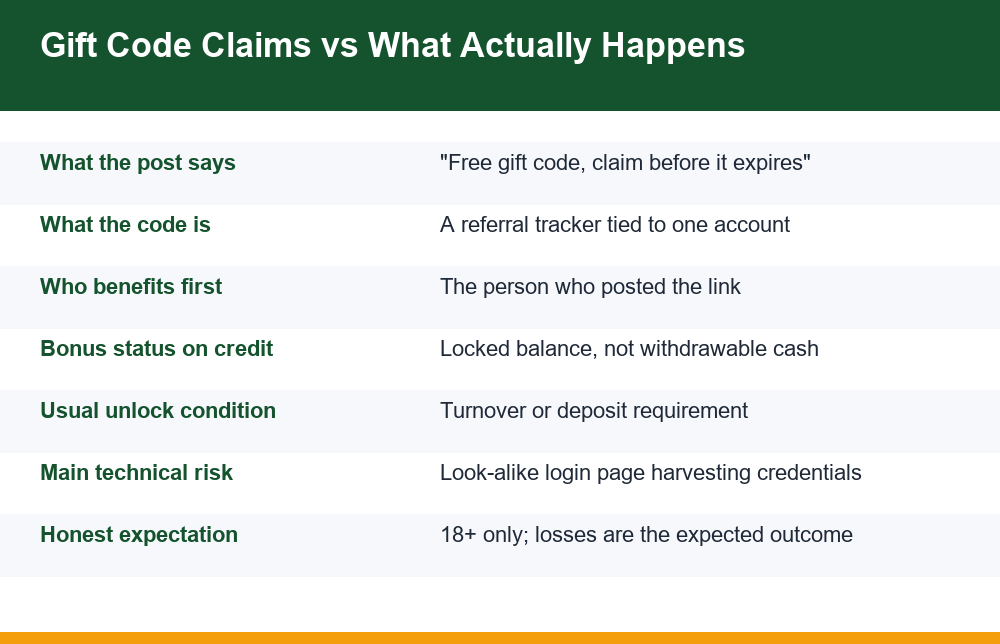
Almost every page ranking for colour prediction gift codes rests on the same unspoken promise: that a short string of characters is free money sitting in an account somewhere, waiting for whoever types it in first. That is the single thing nearly all of these pages get wrong. A code here is not a voucher issued by a shop and it is not a gift from a platform to the public. It is a tracking string.
It records which existing account brought in a new sign-up and a new deposit, and it tells the person who posted it that their chain is growing. Everything stacked on top of that — the screenshots of inflated balances, the countdown urgency, the daily refreshed lists — exists to get a stranger to tap a link. What follows is a breakdown of the mechanics, the terms and the technical risk, without pointing you anywhere to spend money.
What Most Pages About Colour Prediction Gift Codes Get Wrong
Search for colour prediction gift codes and the results look less like information and more like a noticeboard. Dozens of near-identical pages list codes in bold monospace, each with a rupee figure beside it, each dated today. Quote-aggregator sites that otherwise publish shayari and status lines suddenly carry a daily code roundup. Chat channels with generic names repost the same block of text with one character changed. None of these pages explains what a code does. They only assert what it gives.
The omission is the whole problem. Once you know that the string is a referral identifier, every other claim on those pages reads differently. A code cannot be “expiring soon” in any meaningful sense, because it is simply attached to an account and stays attached. It cannot be “leaked” or “working today only”, because there was never a vault it escaped from. And the amount printed next to it is not set by the code at all — it is set by whatever promotional rule the platform is running, which the code neither carries nor controls.
The second thing these pages skip is the distinction between a credited figure and a spendable one. When a promotional amount appears in an account, it usually arrives in a separate locked balance governed by conditions. The number on screen is real as a number. It is not real as cash you can move. Pages that publish only the number and never the condition are not reporting; they are advertising, and they are being paid in sign-ups.
Several patterns show up again and again across this type of content, and spotting them is faster than evaluating each page individually:
- No named source. The code is never attributed to a specific published promotion. It is presented as found, shared or leaked.
- Contradictory amounts. The same code appears on two sites with different bonus figures, which cannot both be rules.
- No terms anywhere. The page lists what you get and is silent on what you must do before you can take it out.
- Mirrored wording. Paragraphs are copied between sites with only the numbers swapped, a sign nobody verified anything.
- No way to ask. There is no author, no contact route and no comment space, so nothing on the page can ever be corrected.
Treat the absence of terms as the finding, not as an oversight. A page that genuinely wanted to inform you would lead with the unlock condition, because that is the only part that determines whether the offer is worth your attention at all. When the condition is missing while the figure is set in bold, the page has told you exactly which of the two it wants you to remember.
Codes, Invites and Referrals: One Mechanism Under Three Names
“Gift code”, “invite code”, “promo code” and “referral code” are used interchangeably across this ecosystem, and that blurring is useful to whoever is posting. The words carry different emotional weight. A gift sounds like something given to you with nothing expected back. A referral sounds like what it is: a commercial introduction where someone earns from your activity.
Underneath, the mechanism is usually one thing. A string is bound to an account. When a new user registers with that string attached, the system records the link permanently. From that point the introducing account may earn a share of the new user’s deposits, turnover or losses, and often a share from anyone that new user goes on to introduce. The structure of those payouts — who earns what, at which depth, on which activity — is the real engine, and it is set out in more depth in our breakdown of how multi-level referral tiers pay out to the people above you.
This matters for reading intent. When someone posts a code to a public channel, they are not distributing a windfall. They are distributing their own identifier as widely as possible, because their earnings scale with how many people attach to it. The enthusiasm in the message is often genuine. It is just enthusiasm about their position, not about your outcome.
It also explains why the posts never stop. A referral identifier does not get used up. One person can post the same string every day for a year to a hundred channels, and each repost has a non-zero chance of recruiting someone. That is why the “today’s codes” lists are endless and why they are always dated today: the date is decoration, applied automatically, to make a static string feel perishable.
A useful mental substitution: every time you read “gift code”, read “someone’s tracking tag”. The sentence “claim this free gift code before it expires” becomes “attach yourself to my tracking tag quickly”. Nothing else about the sentence changes, and the pressure dissolves. It is a small rewording habit, and it does more work than any list of suspicious keywords, because it targets the structure of the claim rather than its vocabulary.
Why Gift Code Links Come From Chat Channels
The concentration of code posts on broadcast chat channels is not an accident of fashion. Channels there support unlimited one-way broadcast to large audiences, instant edits to old posts, link previews that render a destination as a clean card, and effortless creation of a replacement channel if one disappears. For anyone whose income depends on volume of link taps, these are exactly the right properties.
Broadcast-only channels also remove friction in a specific direction. In a normal group, someone who tried a code and got nothing can say so, and the next reader sees it. In a channel where comments are disabled, the poster controls the entire visible record. The feed shows a continuous stream of wins, payout screenshots and fresh codes, and nothing else, because nothing else is permitted to appear.
That filtering has a compounding effect on expectations. A reader scrolling a week of posts is not sampling outcomes; they are sampling a curated subset of outcomes chosen for persuasiveness. The absence of a single disappointed message feels like evidence, when it is only evidence of moderation settings. Any feed that shows a hundred wins and zero losses is describing its own editing policy, not the activity it claims to document.
Many of these channels also run a second business on the same audience. The code posts bring people in for free; paid signal groups, VIP tiers and “guaranteed” prediction subscriptions are then sold to the same list. We cover that second layer separately in our look at what paid prediction and signal groups are actually selling. The short version is that the free code is the top of a funnel, not the product.
There is a practical consequence for links. A channel post can be edited after thousands of people have seen it, so the destination you tap today need not be the destination someone else tapped last week. Link previews make a swapped URL hard to notice, because the card keeps the old title and image while pointing somewhere new. This is the main reason a code link from a chat deserves more caution than the same code typed by hand inside an app you already opened yourself.
None of this requires assuming bad intent from every channel. The structure itself — one-way broadcast, editable history, no counter-evidence, payout tied to taps — produces misleading output even when individual posters believe what they write.
Step by Step: What Happens Between the Code and the Credit
Laid out in sequence, the path from a forwarded message to a locked balance is short, and each step looks minor on its own. Seen in order, the shape of it is much clearer.
- The post arrives with urgency attached. A figure, a deadline and a code. The deadline is the part doing the work, because it discourages the pause in which you would check anything.
- The link carries the identifier. Tapping it does not just open a page; it passes the poster’s tag along so that any account created afterwards is attributed to them.
- Registration binds the link permanently. Once the account exists with that tag attached, the association generally cannot be changed later, which is why the tap is the decisive moment rather than the deposit.
- The promotional figure appears, conditionally. On many offers nothing is credited until a deposit lands first, so the “free” amount is gated behind a real payment from you.
- The credit lands in a separate balance. It can usually be staked but not transferred out, and it is governed by a turnover multiple, a cap and an expiry window.
- Staking begins to erode it. Every round carries a margin in the house’s favour, so the balance trends downward while the requirement is still being worked through.
- The poster is paid regardless. Their earnings depend on your activity continuing, not on your balance surviving, which is why the posts emphasise starting and never finishing.
Nothing in that sequence is hidden in the sense of being concealed. It is all stated somewhere in the platform’s own terms. What the code lists do is remove the sequence and keep only step four’s headline number, which is the one step that reads like a benefit.
What a Gift Code Bonus Actually Requires Before Withdrawal
This is the section the spam pages skip, and it is the only one that decides anything. When a promotional amount is credited, it is normally not treated as your money. It sits in a bonus balance with rules attached, and those rules describe what has to happen before any part of it, or any winnings derived from it, can be withdrawn.
The vocabulary varies between platforms, but the categories of condition are fairly consistent. Reading them once makes every future offer legible at a glance.
| Term you may see | What it generally means | Why it blocks a withdrawal |
|---|---|---|
| Wagering or turnover requirement | The bonus must be staked a stated number of times over | Each round carries a house margin, so the balance usually erodes before the target is met |
| Minimum deposit to activate | The promotional credit only appears after you put your own money in | The “free” amount is gated behind a real payment from you |
| Bonus-only balance | The credit is held in a separate wallet from deposits | It can be staked but not transferred out directly |
| Maximum conversion cap | Only a limited amount derived from the bonus can ever be withdrawn | Any surplus above the cap is removed rather than paid |
| Expiry window | The conditions must be completed within a short period | Unmet conditions void the credit and anything built on it |
| Maximum stake while a bonus is active | Individual stakes are capped until the requirement is cleared | Exceeding the cap can forfeit the credit even if the turnover was completed |
| Verification gate | Identity or payment-method checks before any payout | A withdrawal can stall indefinitely at this step |
Put those together and the arithmetic of colour prediction gift codes becomes clear. A credited amount attached to a turnover multiple is not a gift of that amount; it is an obligation to place a much larger total volume of stakes, on games where the margin favours the house on every single round. The more rounds required, the more certainly the balance trends toward zero before the requirement is satisfied. That is not a flaw in the offer. It is how the offer is designed to behave on average.
It is also worth noticing which of these conditions are easy to breach by accident rather than by choice. A stake cap or an expiry window can be missed while someone is simply playing in the ordinary way, and the result is the same as abandoning the bonus outright. Conditions that can be failed inattentively are the ones most reliably omitted from the pages advertising the figure.
One honesty line worth keeping in view: this is adult-only, real-money activity, and across any meaningful number of rounds losses are the expected outcome. A promotional credit does not change that direction. It changes how long it takes to arrive.
If a page lists a bonus figure and no conditions at all, you have not found a better offer than everyone else. You have found a page that withheld the part you needed.
Can a Gift Code Link Steal Your Login Details?
A code typed by hand into an app you already have installed cannot, by itself, take your credentials. The risk sits almost entirely in the link. A substantial share of code posts do not send you to a platform at all; they send you to a page built to look like a login or a code-redemption screen, whose only function is to capture whatever you type into it.
These pages are cheap to assemble and convincing in the moment, because they only have to survive a few seconds of attention. The layout is copied, the logo is copied, the form fields are copied. What differs is where the form submits. A visitor who enters a phone number, password and the one-time code that arrives immediately afterwards has handed over everything needed for a takeover, and has done it voluntarily, which is why these pages persist.
The signals that give them away are mostly structural rather than visual:
- The domain is a near-miss of a familiar name — an extra word, a swapped letter, an unusual extension, or a long random subdomain in front of the recognisable part.
- The page asks for a one-time passcode on the same screen as the password, which a legitimate redemption flow has no reason to do.
- It opens inside the chat app’s built-in browser, where the address bar is truncated or hidden entirely.
- It asks for payment-app details or a UPI PIN to “receive” a bonus, when nothing legitimate requires an authorisation PIN to pay money in.
- It chains a second link after the first, a redirect pattern used to make the final destination harder to inspect.
- It pushes you to install a file from outside an official app store before the code can be applied.
- The urgency is on the page itself — a countdown, a queue position, a claim that the slot is about to be released to someone else.
The payment-side variant of this pattern is worth understanding on its own, because the request to “approve” an incoming transfer is one of the most effective tricks in circulation; our write-up on how UPI collect requests get dressed up as incoming payments covers the mechanics in detail.
Two habits remove most of this exposure. First, never reach a login screen by tapping a link from a chat or a code-list page. Open the app or type the address yourself, then enter the code inside the session you opened. Second, treat the one-time passcode as unshareable in every circumstance, including when the person asking appears to be support staff. If credentials or money have already gone, India’s official National Cyber Crime Reporting Portal is where online financial fraud can be reported, and acting quickly matters a great deal to the outcome.
Why Every Site Shows a Different Invite Code and Bonus Amount
Open five code pages for the same platform and you will typically see five different strings and five different figures. Readers often assume one of them must be the current, correct one. In practice the contradiction is the expected output of how these pages are produced.
Each page is published by a different person with a different referral identifier, and each has an incentive to display their own. There is no shared source of truth to disagree with, because the strings are not drawn from a common pool. They are personal tags. Five pages showing five codes is five people advertising themselves, not five reports of one fact.
The bonus amounts diverge for a plainer reason: nobody checked. The figure is a headline input. A larger number performs better in a title and in a search snippet, so numbers inflate over time as pages copy and slightly outbid each other. Across a batch of pages you can often watch a figure climb through successive rewrites with no underlying change to any promotion.
Dates behave the same way. Many of these pages insert the current month automatically, so a block of text written long ago presents itself as this week’s list indefinitely. A “verified today” label on such a page tells you a template ran, not that a human confirmed anything.
The same goes for the apparatus of credibility around the figures. Screenshots of balances, payout slips and chat exchanges are all easy to produce and easier still to copy between pages, so their presence adds nothing to the claim. Where two pages show the same screenshot under different codes, the screenshot has already answered the question about both.
The practical conclusion is simple. Disagreement between code pages is not a puzzle to solve by finding the real one. It is evidence that none of them is reporting a verifiable fact, and that the only authoritative statement of any promotional term is the platform’s own published terms, read in full, inside your own session.
Are Colour Prediction Gift Codes Real? A Short Checklist
The honest answer is split. The strings themselves are usually real in the narrow sense that entering one does something — it records a referral link, and in some cases it triggers a conditional promotional credit. The advertised meaning of those strings, as free withdrawable money handed out to the public, is not real. Both halves need stating together, because each half alone misleads.
So rather than asking whether colour prediction gift codes are real, it is more useful to run a short set of checks on any specific code you have been sent:
- Who gains if I use this? If the code is bound to a person’s account, that person earns from your subsequent activity. That is not disqualifying, but it is context the post omitted.
- Where is the condition written? Find the turnover multiple, deposit trigger, cap and expiry in the platform’s own terms. If you cannot locate them, you do not know what the offer is.
- How did I reach the entry screen? A link from a chat is the risky path. Opening the app yourself and typing the code is the safe one.
- Is anything being asked of me beyond the code? A password, a one-time passcode, a UPI PIN or an app install from outside a store are all stop signals.
- What does the arithmetic say? Multiply the credited amount by the turnover requirement. If the required volume of stakes looks implausible, the credit is decorative.
- Would I still want this with the bonus removed? If the only reason to open an account is the promotional figure, the figure is doing work the product cannot.
Any code that fails checks two, three or four does not need further evaluation. The failure is the answer, and no amount of detail on the rest of the page recovers it.
Mistakes to Avoid When a Code Lands in Your Chat
Most harm in this area comes from a handful of repeated errors rather than from exotic attacks. They are all avoidable without any technical skill.
- Tapping the link because the sender is a contact. Forwarded code posts travel through people who never checked them, and a compromised account forwards in a familiar voice.
- Reusing a password. A single harvested password opens every account that shares it; a unique password per account limits a breach to one place.
- Reading the one-time passcode aloud or typing it on a page you were linked to. No legitimate redemption needs it, and it is the final lock.
- Depositing to “activate” a bonus. At that point you have paid for the promotional figure, and the conditions still apply to it.
- Chasing the turnover requirement. Staking more to rescue a locked bonus increases exposure to the margin rather than reducing it.
- Treating a screenshot as proof. Balance figures and payout slips are trivial to fabricate and are circulated precisely because they are persuasive.
- Installing an app file sent in a message. A package delivered outside an official store carries whatever permissions its author chose, and a code is a weak reason to grant them.
If something has already gone wrong, the order of actions matters more than the detail. Change the password on the affected account and on anything sharing that password. Revoke active sessions if the platform offers it. If a payment was involved, contact your bank or payment provider immediately and ask for the transaction to be flagged, keeping the transaction reference, timestamp and amount to hand. Report it on the official portal without waiting, and keep screenshots of the original message, the link and the page it opened.
Finally, a small reframing that holds up better than any specific rule about colour prediction gift codes: nothing in this ecosystem is given away. Every free string, free signal and free group is paid for by someone, and in every case the someone is the person who taps. Knowing that does not require avoiding anything in particular. It just removes the urgency that the entire format depends on, and urgency removed is most of the risk removed with it.
Frequently Asked Questions
Are colour prediction gift codes real?
Partly. The strings themselves usually do something real: they record a referral link between your new account and an existing one, and in some cases they trigger a conditional promotional credit. What is not real is the advertised meaning — free withdrawable money handed out to the public. Any credit that appears normally arrives in a locked bonus balance governed by turnover, deposit, cap and expiry conditions, so the figure you saw in the post is not cash you can move.
Why do gift code links come from Telegram channels?
Because the broadcast-channel format suits anyone whose income depends on link taps. Channels broadcast one-way to large audiences, posts can be edited after the fact, link previews render destinations as clean cards, and a replacement channel is trivial to create. With comments disabled, the poster controls the entire visible record, so the feed shows only wins and fresh codes and never the people for whom nothing worked. Those free code posts also feed paid signal and VIP groups sold to the same audience.
What does a gift code bonus actually require before withdrawal?
Typically a combination of conditions: a wagering or turnover requirement that the credit must be staked over a stated number of times, sometimes a minimum deposit before the credit appears at all, a bonus-only balance that cannot be transferred out directly, a maximum conversion cap limiting how much can ever be withdrawn, a cap on individual stakes while the bonus is active, an expiry window, and identity or payment verification. Because every round carries a house margin, a high turnover requirement usually erodes the balance before the target is reached.
Can a gift code link steal my login details?
A code typed by hand into an app you already have cannot, but a link can. Many code posts lead to pages built to imitate a login or redemption screen, whose only function is to capture what you type. Warning signs include a near-miss domain, a request for a one-time passcode on the same screen as the password, a hidden address bar inside a chat app’s browser, a request for a UPI PIN to receive money, chained redirects, and prompts to install a file from outside an official store. Open the app yourself and type the code instead of tapping links.
Why does every site show a different invite code and bonus amount?
Because the codes are personal referral identifiers, not entries from a shared pool, so each page shows the publisher’s own string. The bonus amounts differ because nobody verifies them — a bigger number performs better in a title, so figures inflate as pages copy and outbid each other. Many of these pages also insert the current month automatically, which makes old text look like this week’s list. Only the platform’s own published terms state any promotional condition authoritatively.