A withdrawal unlock fee scam is any situation where a platform shows you a balance, then demands that you send money before it will release that balance. The label changes constantly — tax, unlock charge, verification fee, activation payment, recharge requirement, clearance deposit — but the mechanic never does. Money has to flow towards the platform before money will supposedly flow back to you. That single reversal is the most reliable fraud signal you will ever encounter on a fake gaming or colour-prediction app, and it is more dependable than reviews, screenshots, badges or support chat tone.
This breakdown covers why the demand appears, how the fee ladder escalates after each payment, the six signs that a platform was never going to pay out, and the one rule that ends the decision in seconds.
The Short Answer: One Rule Settles It
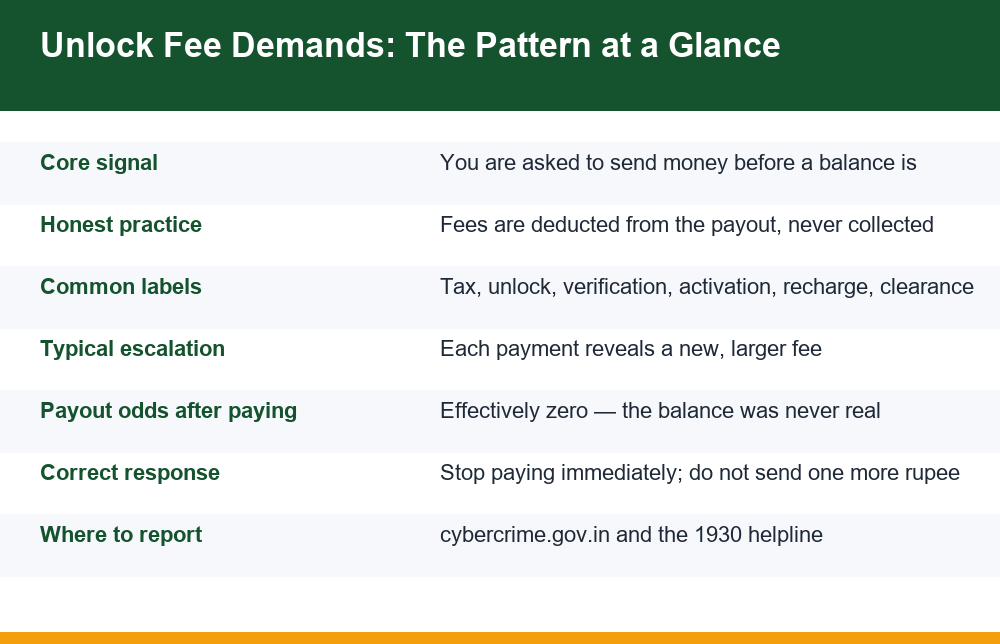
A legitimate payment process deducts charges. A withdrawal unlock fee scam collects them. That distinction is the whole answer, and it holds regardless of how the fee is justified.
When a genuine payout carries a cost — a processing charge, a currency conversion, a bank charge — that cost is taken out of the amount being sent. You asked for 10,000 and 9,800 arrives. You never receive a message saying “send us 200 first and then we will send you 10,000.” No real payment rail works that way, because the money needed to cover a deduction is already sitting inside the transaction. Asking you to fund it separately, from an outside source, makes no operational sense.
It is worth picturing what an honest fee notice actually looks like, because the contrast is sharp. It appears before you confirm, not after. It states a figure or a percentage, and the figure stays the same the next time you withdraw the same amount. It shows you a net total so you can decide whether to proceed. And crucially, it requires nothing of you except tapping confirm — no new transfer, no new recipient, no new app, no conversation with a person. If a charge cannot be described that way, it is not a charge; it is a request.
So the rule is short enough to remember under pressure: if you have to pay to get paid, you are not getting paid. It does not matter whether the demand arrives as an in-app banner, a support agent’s message, a WhatsApp voice note from an “account manager” or a document that looks official. The direction of the money is the tell.
Everything that follows in this breakdown exists to earn that one sentence — to show why the demand is constructed the way it is, what happens in the hours after a first payment, and how to recognise the pattern before any money moves at all.
Why a Gaming App Is Asking You to Pay to Withdraw
The demand is not a glitch, a policy quirk or an overzealous compliance step. It is the business model. On a fake platform, the deposit side is real and the withdrawal side is theatre. Your deposits moved actual money to actual accounts. Your displayed balance is a number in a database that the operator controls completely and can set to anything.
Because that balance costs nothing to create, the operator has every incentive to make it look large and make it look nearly accessible. A big balance behind a small gate produces exactly the psychology the scam needs: the fee feels trivial compared to what it unlocks. Someone staring at a shown balance of 85,000 will weigh a 1,500 “clearance charge” as a rounding error. That ratio is designed, not accidental.
Small early payouts often feed the same effect. On some platforms a first withdrawal of a token amount does complete, and it completes quickly. That single success is cheap for the operator and extremely valuable, because it converts a cautious user into a confident one. From then on the user is not evaluating whether the platform pays — they believe it already has — and the fee demand that arrives later lands as an unusual administrative step rather than a reversal of direction. A payout that worked once is not evidence about the payout being blocked now.
There is a second reason the gate exists. A withdrawal request is the moment a user stops being profitable and starts being a liability. The fee demand converts that moment back into revenue. Instead of paying out, the platform takes one more payment — and then another. Understanding the normal sequence a withdrawal request actually follows makes the deviation obvious: a real request either processes, fails for a stated technical reason, or is declined. It does not generate an invoice.
The justifications you hear are interchangeable precisely because none of them is load-bearing. If you dispute one, a different one appears within minutes. That interchangeability is itself diagnostic.
Anatomy of the Fee Ladder, Step by Step
A withdrawal unlock fee scam almost never consists of a single demand. It is a ladder, and each rung is engineered to feel like the last one. The amounts generally rise, and the explanations grow more elaborate as the user grows more resistant.
The table below maps the labels commonly used against what is actually happening. The sequence varies, but the structure is remarkably consistent across platforms.
| Stage | What you are told | What is actually happening |
|---|---|---|
| First gate | A small processing or service fee is needed to release the payout | A test to see whether you will send money outward at all |
| Second gate | A tax or mandatory deduction is claimed to be due before transfer | Escalation; the first payment proved you are reachable |
| Third gate | Account verification or KYC activation requires a charge | Extraction continues while also harvesting documents |
| Fourth gate | A minimum balance, recharge or wallet top-up is required | Reframing extraction as something you keep, which you do not |
| Fifth gate | A failed transfer must be re-initiated with a correction fee | Manufactured error to justify another round |
| Final stage | Urgent deadline, account freeze threat, or silence | Pressure to maximise the last payment before the exit |
Notice that the ladder has no top. There is no amount at which the balance releases, because there is no balance to release. The ladder ends when the user stops paying or the operator abandons the account — not when the fees are satisfied.
Notice too that the labels borrow authority from things that do exist elsewhere. Processing charges exist. Verification steps exist. Minimum balances exist. The scam works by taking a familiar word and inverting the direction of the money attached to it.
One structural detail is worth holding on to: each rung is justified by the rung before it. The verification charge is explained by the size of the balance you were chasing. The correction fee is explained by the transfer that supposedly failed. The reduced final fee is explained by the goodwill you have shown. A chain of reasons that only refers back to itself never touches anything outside the conversation, which is exactly why no amount of questioning inside the conversation can resolve it.
Is a Withdrawal Tax or Unlock Fee Ever Genuine?
No. Not as a separate payment you are asked to send. This is worth stating flatly, because scam operators rely on users assuming there might be some legitimate version of the request that they simply have not encountered before.
Here is the mechanical reason, which is worth understanding rather than just accepting. Any charge attached to a payout is, by definition, a reduction of that payout. The funds to cover it are already inside the transaction. Routing you out to a separate payment channel to fund a deduction on money the platform claims to be holding is a round trip that accomplishes nothing — unless the point is to collect, which it is.
Three distinctions help here, because genuine friction does exist and it looks nothing like a withdrawal unlock fee scam:
- A deduction reduces what arrives. You see a smaller credit, not an outgoing payment request. This is normal.
- A hold or delay means nothing moves yet, in either direction. Frustrating, but not a fee demand.
- A declined request comes with a stated reason and no invoice. You may disagree with the reason; you are not asked to pay to overturn it.
- A fee demand asks you to initiate a transfer outward. There is no honest version of this at the withdrawal stage.
The word “refundable” deserves its own warning, because it is the most effective softener in the whole script. A fee described as refundable, adjustable against your balance, or returned together with the payout sounds like a deposit rather than a loss, and that framing lowers resistance more than any amount of urgency does. But a refund is a promise made by the same party that is already withholding your money, and it is enforced by nothing. Treat a refundable fee exactly as you would treat a non-refundable one: it is money leaving, and the promise attached to it has no mechanism behind it.
Documents do not change this either. Operators circulate official-looking letters, receipts, reference numbers and screenshots of “pending transfers” to make the demand feel procedural. A PDF proves nothing about where money goes; it proves only that someone can make a PDF. The same applies to a support agent who sounds patient, well-informed and sympathetic — tone is the cheapest thing in the entire operation to fake.
What Happens After You Pay the First Unlock Fee
The first payment does not fail. That is the part most people do not expect. The transfer completes, the agent confirms receipt, and often something visibly changes in the app — a status flips from “pending” to “processing”, a progress bar appears, a reference number is issued. This is deliberate. Visible progress is what makes a second payment thinkable.
Within a short window, usually hours, a new obstacle surfaces. It is framed as the final one, and it is framed as not the operator’s fault: a bank rejected the batch, a deduction band applied to your amount, a verification tier was triggered by the size of your balance, a system migration requires re-initiation. The amount is larger than the first, and the reasoning now includes your own earlier payment as sunk justification — you have already come this far.
From that point the dynamic shifts in a way that is predictable enough to write down in advance:
- Your contact details are now confirmed working, so outreach intensifies — calls, WhatsApp messages, a dedicated “manager” assigned to your case.
- The demands acquire deadlines. Pay within two hours or the balance is forfeited; pay today or the account is frozen.
- Partial payments are accepted and treated as good faith, which keeps you engaged rather than resolving anything.
- If you resist, a sympathetic second voice appears offering a “reduced” fee, which is simply a lower-priced continuation of the same ladder.
- Your number and payment details may be circulated, producing fresh approaches from unrelated accounts weeks later, sometimes posing as recovery agents who can retrieve your money for a fee.
That last step deserves emphasis. The recovery-agent follow-up is a second scam layered on the first, and it targets the same vulnerability. Anyone promising to retrieve lost funds in exchange for an upfront payment is running the identical mechanic with new wrapping.
6 Warning Signs of a Withdrawal Unlock Fee Scam
These signs rarely appear alone. One is enough to stop; two or more together mean the outcome is already decided, whatever the balance on screen says.
- Any outward payment is required before a payout. This is the definitive sign and it needs no corroboration. A platform that collects rather than deducts has told you what it is.
- The fee is explained differently each time you push back. A genuine charge has one explanation that survives questioning. A fabricated one mutates, because it was never derived from anything.
- Deposits are instant and effortless; withdrawals require human intervention. A gap in build quality between the money-in and money-out paths reflects where the effort went — and where it never went.
- Support communication lives outside the platform. When fee instructions arrive by WhatsApp, Telegram or a personal number rather than through the app’s own record, there is deliberately no audit trail.
- Payment is directed to an individual rather than a business account. A personal UPI handle, a named beneficiary, a changing account each time, or a request to use a specific wallet all indicate money moving to a person, not an organisation.
- A deadline is attached to the fee. Urgency is not a feature of payment systems; it is a feature of persuasion. Legitimate processes do not expire your balance because you asked a question.
Two of these connect to broader patterns worth recognising. The payment-direction sign overlaps heavily with the way UPI collect requests and handle-switching are misused, where a single approval tap is dressed up as a verification step. And the sign about communication moving off-platform is the same mechanic behind lookalike login pages — knowing how to confirm you are on the real page rather than a clone removes a whole category of approach before any fee is ever mentioned.
The signs also work as a checklist you can run in under a minute, which matters because these demands are usually delivered under time pressure. Ask four questions in order: which direction is the money going, who is the named recipient, where did the instruction arrive, and does the explanation match what I was told last time. You do not need all four answers to decide. The first one alone settles it in almost every case, and the remaining three only confirm what the first already established.
One more observation about the warning-sign list: none of these items requires you to assess whether the platform is reputable, well-reviewed or widely used. That is intentional. Reputation signals are the easiest things to manufacture. Mechanics are not.
The Stop-Point Rule and What to Do Next
The hardest part of a withdrawal unlock fee scam is not identifying it. It is accepting the arithmetic once identified. People continue paying not because they still believe, but because stopping means writing off what they have already sent. The ladder is built on that reluctance.
So the stop-point rule is framed to remove the comparison entirely: the next payment has no relationship to the previous ones. Money already gone is gone. The only live question is whether sending more money today produces a payout today, and the answer established above is no, because the balance it is meant to unlock does not exist outside a database field. Paying a sixth time cannot rescue the first five; it can only make the total larger.
Practical steps once you reach that point:
- Send nothing further — including any amount framed as reduced, final, partial or refundable.
- Capture evidence before it disappears. Screenshot the balance, the fee demands, the chat history, the payment instructions and every reference number. Fake platforms delete accounts and chats quickly once a user stops cooperating.
- Record the payment trail. Transaction IDs, UTR numbers, dates, amounts and recipient details from your own bank or UPI app statement — this is the part you control and it survives even if the app vanishes.
- Contact your bank or payment provider promptly about transactions you are disputing, and ask what their process requires. Speed matters more than completeness here.
- Stop responding to the account manager. Continued contact produces pressure and new offers, not resolution. Block and move on.
- Treat every later recovery offer as the same scam. No legitimate party asks for an upfront payment to retrieve funds.
A short honesty note that belongs here: real-money play carries risk, losses are the expected outcome over time, and all of this is adults-only. But a fee demand is not a loss from play — it is a separate extraction attached to play, and it is worth separating the two clearly in your own accounting.
Where to Report This Kind of Payment Fraud in India
Reporting a withdrawal unlock fee scam serves two purposes: it starts whatever process may apply to your own transactions, and it adds data to a system that tracks accounts receiving these payments. The second matters even when the first does not resolve in your favour, because the recipient accounts are usually reused across many victims.
The central channel for online financial fraud in India is the National Cyber Crime Reporting Portal at cybercrime.gov.in, which handles financial-fraud complaints and is paired with the 1930 helpline for cases where money has already moved. Reporting early is substantially more useful than reporting completely — you can supplement a complaint later, but a delay narrows what any party can act on.
Have the following ready before you begin, because it is what every channel will ask for:
- Transaction identifiers — UTR or reference numbers, dates, exact amounts, from your own bank or payment app statement.
- Recipient details exactly as they appeared: UPI handle, account number, beneficiary name, wallet identifier.
- The platform name, website or app as it was presented to you, plus any download link you were sent.
- Screenshots of the balance shown, every fee demand, and the full message history with whoever instructed the payments.
- Phone numbers and messaging handles used to contact you, including any that changed mid-conversation.
Also notify your own bank or payment service provider directly through their official app or customer channel, separately from the portal complaint. The two run in parallel and neither substitutes for the other. And if the experience has left you shaken — which is a common and reasonable reaction, particularly where significant amounts are involved — free mental-health support lines exist and using one is not an overreaction.
Mistakes to Avoid Once You Spot the Pattern
People who correctly identify a withdrawal unlock fee scam still sometimes lose more afterwards, through a predictable set of errors. These are worth knowing in advance.
- Negotiating the fee. Arguing an amount down concedes that some amount is owed. There is no correct figure to arrive at.
- Making one final test payment. The smallest amount you can send is still a confirmation that you send. Every subsequent demand is built on it.
- Sharing documents to “complete verification”. Identity documents and card images handed over during a fee dispute create exposure well beyond the money involved.
- Granting remote access. Any request to install a screen-sharing or support tool so an agent can “fix the transfer” should end the conversation immediately.
- Deleting the app before capturing evidence. Uninstalling first destroys the material any complaint depends on. Screenshot, then remove.
- Assuming a different platform is safer by comparison. The fee mechanic is not a property of one operator; it is a template. The warning signs transfer intact.
- Staying silent out of embarrassment. These operations are built by people who do this full time, against psychology that works on nearly everyone. Not reporting protects only the operator.
There is also a quieter mistake: continuing to hold the account open “just in case” the balance releases later. It will not, and an open account keeps a channel available for the next approach — a notification, a bonus offer, a new manager, a fresh reason to deposit. Closing the loop properly means removing the app, cutting the contact, and treating the displayed figure as what it always was: a number someone typed.
If there is one thing to carry away, make it the direction-of-money test rather than any specific list of red flags. Fee labels will keep changing, platform names will keep rotating, and the interfaces will keep improving. The inversion at the centre of a withdrawal unlock fee scam — pay first, get paid later — cannot be redesigned away, because it is the entire point of the exercise. Once you check direction before anything else, the rest of the ladder never gets built.
Frequently Asked Questions
Why is a gaming app asking me to pay a fee to withdraw?
Because the fee is the revenue, not an administrative step. On a fake platform the deposit path is real and the displayed balance is a database value the operator sets freely. A withdrawal request is the point where a user stops being profitable, so the demand converts that moment back into income. The justification given — processing, tax, verification, activation — is interchangeable, which is why it changes whenever you dispute it.
Is a withdrawal tax or unlock fee ever genuine?
Not as a separate payment you are asked to send. Any real charge attached to a payout is deducted from that payout, because the funds to cover it are already inside the transaction. Being routed to an outside payment channel to fund a deduction on money someone claims to be holding for you serves no operational purpose except collection. Official-looking receipts, reference numbers and promises that the fee is refundable do not change this.
What happens after I pay the first unlock fee?
The payment succeeds and something visibly changes in the app — a status flip, a progress bar, a reference number — which is what makes a second payment thinkable. Within hours a new, larger obstacle appears, framed as final and as someone else’s fault. Contact then intensifies because your details are confirmed working, deadlines get attached, partial payments are accepted to keep you engaged, and weeks later recovery agents may approach with the same mechanic in new wrapping.
How do I recognise a platform that will never pay out?
Six signs: any outward payment required before a payout; a fee explanation that mutates under questioning; instant deposits paired with manual withdrawals; fee instructions arriving on WhatsApp or Telegram rather than through the platform’s own record; payment directed to a personal handle or a changing beneficiary rather than a business account; and a deadline attached to the fee. None of these requires you to judge the platform’s reputation, which is the easiest thing to fake.
Where do I report this kind of payment fraud in India?
The central channel for online financial fraud is the National Cyber Crime Reporting Portal at cybercrime.gov.in, paired with the 1930 helpline where money has already moved. Report early rather than waiting to assemble everything. Have transaction identifiers, recipient details, the platform name, screenshots of the balance and fee demands, and the contact numbers used. Notify your own bank or payment provider separately as well — the two processes run in parallel.