You opened the app to check a balance and instead got a wall: account suspended, access restricted, or just a login screen that refuses your password — and a cricket ID blocked message is frustrating precisely because it almost never explains itself. There is money sitting behind that screen, a support inbox that answers in templates, and search results full of forum threads where nobody says what actually happened. This breakdown skips the shouting.
It covers the handful of triggers behind most blocks, what each one does to a balance, how a review request realistically works, and which reflex reactions make the situation worse. One honesty line before anything else: real-money play is 18+, losses are the expected outcome over time, and no part of this page is advice to play anywhere.
What a cricket ID blocked notice actually means
The first thing worth sorting out is whether you are looking at a genuine restriction or an ordinary login failure. A wrong password, an expired session, a changed phone number, a switched SIM, an app version that is no longer supported, or a payment partner that is temporarily down can all produce screens that feel identical to a block. A cricket ID blocked state is different in one specific way: the credentials are accepted somewhere in the system, but the account itself has been placed in a restricted condition by a person or an automated rule.
Platforms rarely use one word for this. The same underlying condition shows up as suspended, frozen, locked, under review, pending verification, temporarily unavailable, or a flat contact support. The vocabulary is not standardised, so the label tells you less than the behaviour does. What matters is which actions still work.
The three states you are most likely in
- Restricted but open. You can log in and see the balance, but deposits, withdrawals or placing anything are refused. This is the mildest state and usually the most recoverable, because the account is still yours to interact with.
- Suspended. Login is refused outright. The balance is normally still recorded on the platform’s side, but you cannot see it. Everything now depends on the support channel.
- Closed. The account has been ended rather than paused. This is the hardest state to reverse, and it is often the end point of a review that found something the platform treats as a terms breach.
Work out which of the three applies before you write to anyone. A restricted-but-open account can often be fixed by finishing a document upload. A suspension needs a written request with evidence attached. Treating all three the same way is how people end up sending five emails that say nothing useful.
One more distinction: a block applied to a single account is not the same as a platform going dark on everyone at once. If other people using the same service are also locked out on the same day, you are probably looking at an outage or an operator-side problem rather than something attached to your account. A quick way to tell them apart is the login screen itself. A general outage usually fails before your password is even checked, while an account-level restriction accepts the credentials and then stops you at the next step.
Cricket ID blocked: 5 honest reasons it happens
Blocks feel random, but in practice a small set of triggers accounts for most of them. None of them require you to have done anything dramatic. Most are administrative.
| Trigger | What usually sets it off | What it typically affects |
|---|---|---|
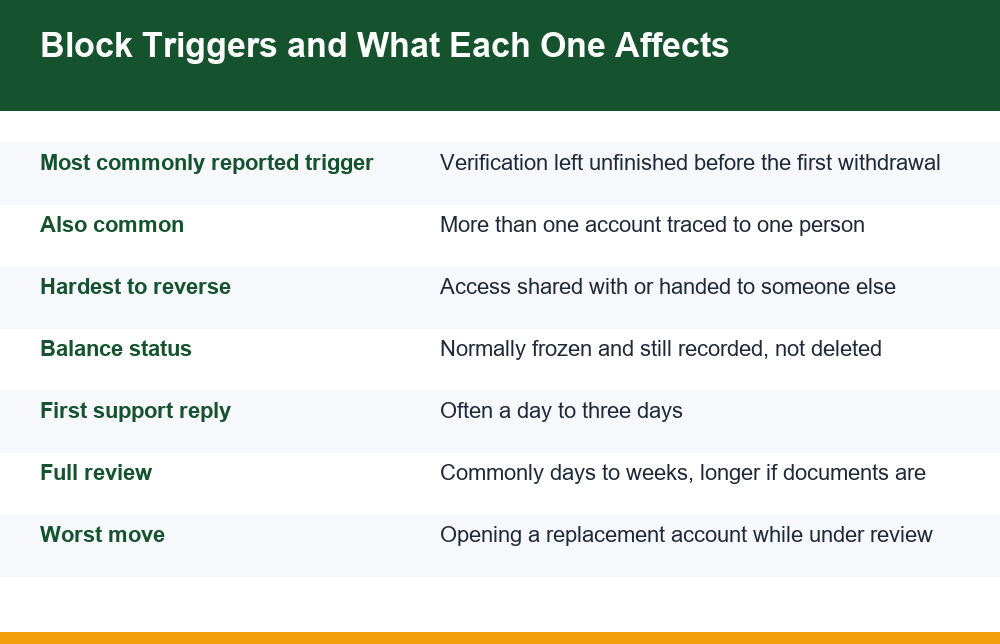
| Unfinished verification | Documents never uploaded, blurred, expired, or a name that does not match the payment method | Withdrawals blocked first, then full access |
| Multiple accounts | A second sign-up on the same device, number, email pattern or payment instrument | All linked accounts restricted at once |
| Shared or transferred access | Two or more people using one login, or an account handed over to someone else | Usually the hardest block to reverse |
| Terms breach | Promotion conditions broken, third-party payment used, details that do not match | Balance held pending a review |
| Long inactivity | Months with no login, or a dormancy rule in the terms | Account parked; often reopens after re-verification |
Verification left halfway
This is the most commonly reported reason, and the most fixable. Many accounts are created and funded in minutes with nothing more than a phone number, and the identity step is postponed until the first withdrawal request. At that moment the checks run in full. If the name on the submitted document does not match the name on the bank account or UPI handle used to deposit, the account goes into a hold rather than paying out. The mismatch is often trivial — a middle name, an initial, a spelling variant carried over from an old document — but automated matching does not forgive it.
The fix is unglamorous: upload a clear, current document in the registered name, and make sure the deposit method carries that same name before you ask for anything else.
More than one account traced to one person
Most sets of terms limit a person to one account. People break this rule without meaning to: they forget an old sign-up, create a fresh one after losing access to an email, or register again to claim an offer. The matching does not rely on your word for it. Device identifiers, phone numbers, email patterns and payment instruments are all compared. When a duplicate is found, both accounts are commonly restricted together, and the balance on each is held while the overlap is examined.
Access shared with other people
One login used by a brother, a friend, a flatmate or a group is treated as a serious breach almost everywhere, because it defeats the whole point of identity checks. Behavioural signals make it visible: two cities in one evening, two devices logged in at once, patterns that do not fit one person. If you want the longer version of how this is detected and why it is so hard to argue your way out of, the breakdown on what happens when family members share one account covers it in detail.
A term you did not read
Promotion conditions, deposit-source rules, and requirements that the payment method belong to the account holder are the usual suspects. Paying in from a relative’s account to save a few minutes is a frequent trigger. So is accepting a promotional credit and then moving money in a pattern the terms describe as abuse. None of this requires intent — the rule is applied as written. This is also the category where reading two paragraphs at sign-up would have cost nothing and prevented everything.
Dormancy
Accounts that sit untouched for months get parked. Some terms also describe administrative deductions from dormant balances. A dormancy block is usually the mildest of the five and tends to lift once identity is re-confirmed, though the balance may be smaller than you remember.
Can I get my money out of a blocked account?
The honest answer is: sometimes, and the odds depend entirely on which trigger you are dealing with. When a cricket ID blocked state comes from unfinished verification or dormancy, the balance is normally frozen rather than removed, and it becomes payable once the identity and payment-name checks pass. When the block follows a duplicate-account finding or a shared-login finding, outcomes vary widely, and platform terms commonly describe circumstances in which winnings are withheld while deposits are returned, or in which nothing is returned at all.
A few practical realities worth knowing before you start chasing a payout:
- A frozen balance is usually still recorded in the account history even when the dashboard is not reachable. Screenshots taken before you lost access are far more useful than anything you can capture after.
- Payouts go back to the same instrument you deposited from, in the same name, as a rule. If that account is closed, the payout stalls regardless of whether the block is lifted.
- A balance built mostly from promotional credit is not the same as a balance built from your own deposits. Promotional funds carry conditions and are routinely voided during a review.
- Partial resolutions happen often: deposits returned, promotional winnings withheld. That is a normal outcome rather than an unusual one.
- A review decision is final from the platform’s side. There is no second desk inside the company that overturns the first one on request.
If you have not yet dealt with a payout on this platform at all, the mechanics matter more than you would expect — thresholds, name matching, processing windows and the documents requested at each stage. The walkthrough of how a cricket ID withdrawal is processed step by step explains where requests stall even on healthy accounts, which is useful context for reading a block notice correctly.
Set expectations honestly. Money held behind a block is not a guaranteed recovery, and treating it as certain leads people into the second mistake described further down this page: paying someone who promises to get it back.
Does sharing one ID between people get it blocked?
Yes — reliably, and more quickly than most people expect. Sharing is one of the few triggers that platforms detect with high confidence and treat with little flexibility, because the entire verification structure assumes one named person behind one account.
The signals are mundane but hard to explain away. Two sessions open from different devices at the same minute. Logins from two cities an hour apart. A device identifier that has also appeared under a different account name. A payment instrument belonging to someone other than the registered holder. Any one of these can start a review; two or three together generally end it.
The common versions of this are not schemes. A father registers and his son plays. A group of friends chips in on one account because only one of them completed verification. Someone travels and asks a relative to log in and check something. All of these read, from the platform’s side, exactly like account sharing, because in substance they are.
What makes sharing so much harder to recover from than a verification problem is that there is nothing to fix. A blurred document can be re-uploaded. A name mismatch can be evidenced with a bank statement. A second person behind the login cannot be undone after the fact, and any explanation of it is also an admission. That is why a confirmed sharing finding tends to end in closure rather than a conditional reinstatement, and why arguing the point in a support thread rarely changes the outcome.
There is also a specific scam pattern worth naming here, purely as a warning. People are offered a "ready-made" or pre-verified account by a stranger on a messaging app, sometimes with a balance supposedly already in it. Accounts obtained that way are registered in another person’s name, which means the buyer can never pass a verification check and has no claim to anything inside. The block, when it arrives, is total, and the seller is unreachable by then. This is described so you can recognise the offer and refuse it, not as a route to consider.
How do I ask the platform to review a block?
A review request is an administrative exercise, not a negotiation. The people reading it are working through a queue against a checklist, and the requests that move fastest are the ones that let them tick boxes without writing back for more. When a cricket ID blocked notice appears, the sequence below gets you to a decision with the least friction.
- Write down the exact wording on screen, with the date, the time, and a screenshot. The specific phrase often indicates which internal rule fired.
- Use the platform’s own channel first — the in-app ticket or the official support address printed in the account area. Messages sent through social media accounts or chat groups that merely look official go nowhere at best.
- Open one thread and keep it. Reply inside it rather than starting new tickets. Duplicate threads reset your position in the queue and make the history harder to read.
- State the facts in six lines or fewer: registered name, registered number, the date access stopped, the on-screen message, and what you are asking for. No history, no argument, no threats.
- Attach documents before they are requested. A clear photo of the identity document in the registered name, plus a statement or screenshot showing the payment instrument in that same name, pre-empts the most common follow-up.
- Ask for a reference number and the expected review window, then stop writing. Chasing daily does not accelerate a queue; it adds noise to your own file.
- Record every reply. Dates, names, reference numbers. If the matter ends up anywhere other than the support inbox, this record is the only thing you will have.
If the platform stops replying altogether, or the account was funded through a payment service and the transaction itself is in dispute, the consumer grievance route is the ordinary place to log it. India’s National Consumer Helpline portal accepts complaints online and by phone, issues a reference number, and forwards the matter to the business concerned; it is a government service and costs nothing. Keep the expectation modest, since a logged complaint is a record and a referral rather than a guaranteed recovery, but it is free and it creates a paper trail that your own emails do not.
Tone matters more than people assume. Reviews are read by people who deal with abuse all day. A short, factual, unemotional message with the right attachments gets better handling than a long one, every time.
Will making a second account fix a blocked ID?
No. It is the most reliable way to turn a recoverable situation into a closed one. This is worth stating plainly because it is the first instinct almost everyone has when a cricket ID blocked screen appears and support is slow.
Registering again does not create a clean slate. The new sign-up is matched against the existing one through the device, the phone number, the email pattern, and above all the payment instrument. When the link is found — and it is usually found at the first withdrawal attempt, because that is when the full checks run — the platform now has a duplicate-account finding on top of whatever the original block was about. A pending review that might have ended with a payout becomes a confirmed terms breach.
The related shortcuts fail for the same reason:
- Signing up with a relative’s identity documents creates an account you cannot verify as yourself and cannot withdraw from.
- A new phone number on the same handset changes almost nothing, because the device is part of the match.
- A different payment instrument in the same name links the accounts immediately.
- A VPN or a new device does not undo an existing identity record; it only adds an inconsistency to the file.
There is a second cost people miss. A duplicate account usually means money moving in again, on top of a balance already stuck behind a review, which is how a frozen amount quietly doubles. The patient route is dull and it is the one that works: finish verification in your own name, submit the review request once, keep the thread, and accept that the answer may be no.
Device and location changes that start a review
Some blocks have nothing to do with wrongdoing and everything to do with a pattern that changed suddenly. Security systems are tuned to notice discontinuity, and some entirely ordinary life events look exactly like a compromised account.
Typical examples: a new handset, a reinstalled app, a switch from mobile data to an unfamiliar network, a long gap followed by a large deposit, several failed login attempts before a successful one, or travel that puts the session somewhere the account has never connected from. Any of these can trigger a precautionary hold, which is often lifted quickly once identity is re-confirmed, and that is a much better position to be in than a terms review.
Travel is the most frequently misunderstood version. Connecting from somewhere new routinely produces a restriction while checks run, and people compound it by reaching for tools that mask the connection, which looks far worse than the original anomaly. The piece on what tends to happen to an account when you travel or change country goes through the signals involved and why the masking reflex backfires.
Telling a precautionary hold apart from a terms review is usually possible from the wording alone. A hold tends to ask you for something — a code, a document, a confirmation — while a terms review simply states that the account is under review and gives you nothing to do. If the screen is asking, answer it, and the matter is normally over in minutes.
The practical takeaway is small but real: keep the registered phone number and email reachable and current. A precautionary hold is normally resolved by a code sent to one of them. If both are stale, a five-minute problem becomes a support ticket with a document request attached.
Cricket ID blocked: mistakes to avoid during a review
The period between the block and the answer is when most of the avoidable damage happens. Four mistakes account for nearly all of it.
Paying anyone who promises to unblock it
Messaging groups and comment sections are full of people advertising themselves as recovery agents, insiders, or account specialists who can lift a block for a fee. There is no such role. No outside party can reverse a platform’s internal decision, and the fee is the entire product. The pattern is predictable: a small payment to begin, then a larger one for an invented obstacle such as a clearance charge or a processing fee, then silence. Some of these contacts then ask for identity documents or screen-sharing access, which turns a frozen balance into a much larger problem. Treat every unsolicited recovery offer as a scam, including the ones that arrive right after you post about your block in public.
Posting account details anywhere public
Complaining in a forum thread or a comment section with your registered number, user ID or transaction references visible is an invitation. The people who respond fastest to those posts are not there to help. Keep identifiers inside the official support thread.
Sending documents to an unofficial address
Identity documents should only ever go into the platform’s own upload form or its published support address, checked against what is shown inside your account rather than what a search result or a chat contact told you. A look-alike domain, a free email address, or a messaging app contact claiming to be from the verification team is the most common way an account problem becomes an identity-theft problem.
Trying to force the issue
Ten tickets, a dispute raised on the deposit while a review is open, and aggressive messages all slow a file down rather than speeding it up. One thread, one set of facts, one set of documents, then wait.
Step by step: what to do in the first week
Here is the sequence compressed into something you can follow in order. The timings are typical rather than promised; platforms differ, and a file missing documents can sit far longer than the ranges below.
| Stage | What to do | Typical wait |
|---|---|---|
| Hour 1 | Screenshot the message. Confirm it is not an outage or a password problem. | Immediate |
| Day 1 | Open one official support ticket with the six facts and your documents attached. | Often a day to three days for a first reply |
| Day 2 to 3 | Answer any document request once, clearly. Do not open a second ticket. | Same window |
| Day 3 to 10 | Wait. Keep the reference number and every reply. | Commonly days to weeks for a decision |
| If no reply | Log the matter through the consumer grievance route with your records attached. | Varies by case |
| Whatever the outcome | Do not register again and do not pay a recovery contact. | Ongoing |
A final, unglamorous point. A cricket ID blocked notice is usually the moment someone discovers how much of their money was sitting in a place they could not reach, under terms they had not read, with a support channel that answers in days rather than minutes. Whatever the review decides, that is the part worth remembering: access can be removed at any time, by rule or by error, and a balance held on someone else’s system is never fully in your hands. Real-money play is for adults, and losses are the expected result over time, so keeping the amount at stake small enough that a sudden block is an inconvenience rather than a crisis is the only reliable protection against this entire category of problem.
Frequently Asked Questions
Why has my cricket ID been suspended?
In most cases it is one of five routine triggers rather than anything dramatic: verification left unfinished (especially a name mismatch between your identity document and the payment method used to deposit), more than one account traced to the same person, a login shared with or handed to someone else, a breach of written terms such as a promotion condition or a third-party payment, or a long period of inactivity. The exact wording on the screen — suspended, restricted, under review, pending verification — often hints at which rule fired, so note it before contacting support.
Can I get my money out of a blocked account?
Sometimes, and it depends on the trigger. If the block came from unfinished verification or dormancy, the balance is normally frozen rather than removed and becomes payable once identity and payment-name checks pass. If it followed a duplicate-account or shared-access finding, the terms commonly allow the platform to withhold winnings, and partial outcomes are normal: deposits returned, promotional winnings voided. Payouts almost always go back to the original instrument in the registered name, so a closed bank account stalls the process regardless of the review’s result. Do not treat held money as a certain recovery.
Does sharing one ID between people get it blocked?
Yes, and it is one of the most reliably detected breaches. Verification assumes one named person per account, so two simultaneous sessions, logins from two distant cities in a short window, a device that has appeared under another account name, or a payment instrument belonging to someone else all stand out. The usual cases are innocent in intent — a parent registers and someone else plays, friends pool into one verified account — but they look identical to deliberate sharing and are treated the same way. Buying a pre-verified account from a stranger is worse still: it is registered in another name, so it can never be verified by the buyer.
How do I ask the platform to review a block?
Use the platform’s own in-app ticket or the support address shown inside your account, never a contact found in a chat group or social media reply. Open one thread and keep it. State only the facts: registered name, registered number, the date access stopped, the exact on-screen message, and what you are asking for. Attach a clear identity document in the registered name and proof that the payment instrument is in the same name before they are requested. Ask for a reference number and the review window, then wait rather than chasing daily. Keep a record of every reply.
If support goes silent, the matter can be logged free of charge through India’s National Consumer Helpline, which issues a reference number and forwards it to the business concerned.
Will making a second account fix a blocked ID?
No — it is the most reliable way to make things worse. A new registration is matched to the old one through the device, phone number, email pattern and especially the payment instrument, and the link is normally found at the first withdrawal attempt when the full checks run. At that point a pending review that might have ended in a payout becomes a confirmed duplicate-account breach. Registering with a relative’s documents, changing the number on the same handset, or using a VPN do not break the link; they only add inconsistencies to your file. Finishing verification in your own name and submitting one review request is the slower route that actually works.